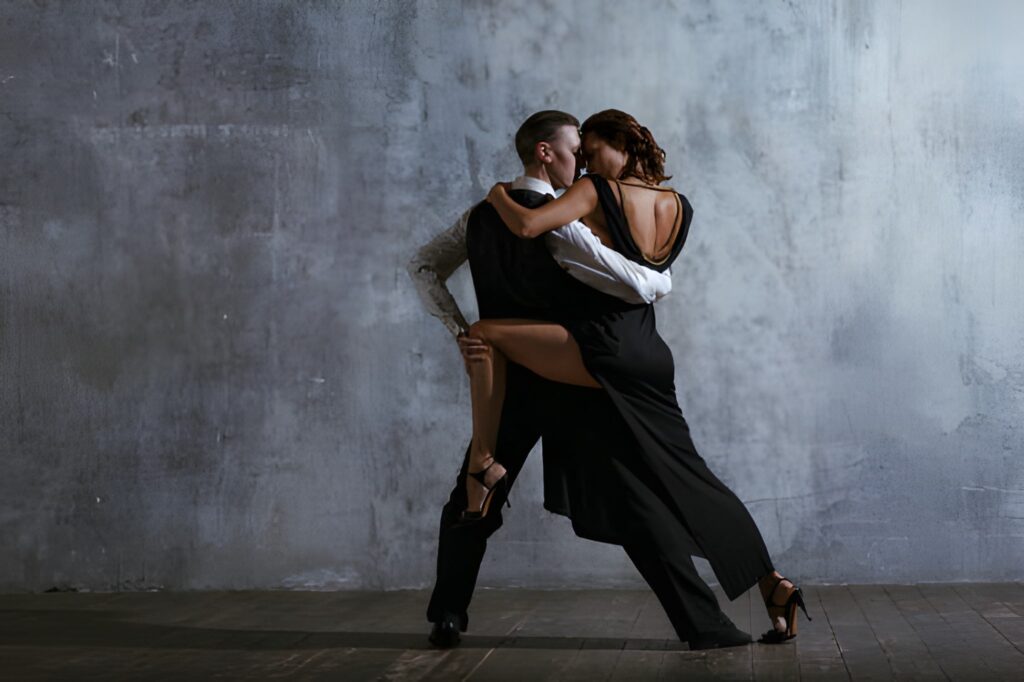
Learning how to dance involves exploring dances that may not be your favorite, or ever entered into your mind until that point. This article aims to clarify how the variety of dances work together to create a Dance House.
How to Create Your Own Dance House
Think of your dance program like building a house. Some rooms you use every day. Others are reserved for special occasions. And just like a well-designed home, every room serves a purpose – even the ones you don’t visit as often.
The biggest mistake new dancers make? They want to live in one room. They find a dance they love and ignore everything else. But here’s the thing – a house with only a living room isn’t much of a house, is it?
Your Dining Room
The “fine china” of dances is the Waltz, no question. The dining room is the special occasion room. You host parties, drink tea from the silver tea set, and generally use half the wedding gifts you got. Waltz is the most classic and formal form of partner dancing. It’s the best dance for developing posture, balance, and, similar to your dining room, an overall feeling of royalty. Without a dining room, you’d be hosting dinner parties in your kitchen. Without Waltz, your go-to formal dance is something designed to be less than formal. So the verdict is: have it in your house and use it for special occasions – and to store your fancy stuff.
In fact, even if you never plan to waltz at a ball, the skills you develop here transfer everywhere. The posture, the frame, the smoothness – these become the foundation that makes all your other dances look better.
Your Media Room
This isn’t your high traffic family room. This is your media room. Your home theatre, surround sound, get-your-popcorn-ready cinematic escape chamber. This is, without question, a non-essential, but incredibly cool room to have in your house. The dance equivalent is the Tango. It’s not incredibly practical, but it gives you a great feeling. Tango, as a dance, gives you the same feeling that a great movie gives you: an escape. While you’re not going to find as many practical options with Tango (i.e. “I went to that wedding reception and danced Tango all night!”). However, just like a media room, if you have one – you talk about it. Nothing will earn you more cool points with your skeptical-about-you-dancing friends, than casually mentioning that you’re learning the Tango.
The Tango is your conversation starter. It’s what people picture when they imagine dramatic, passionate dancing. And while opportunities to use it socially might be rare, the confidence it builds is anything but.
Your Kitchen
The kitchen is where things get hot and where you keep your spice. The hot and spicy dance is the Rumba. We commonly refer to the Rumba as “the kitchen dance” because it’s a pretty romantic place to use your dancing. The kitchen is one of the “high traffic” areas in your home, and your Rumba should be no different. Rumba will, forever and ever, be your go-to slow dance. Without a kitchen, you’re relegated to fast food. Without the Rumba, you’re relegated to fast-dancing. So, slow things down, get spicy, and keep the kitchen dance as a big part of your dance program.
Every wedding, every party, every evening out – there will be slow songs. Your Rumba is the answer. It’s the dance that turns a slow song from awkward swaying into something meaningful.
Your Game Room
Whether it’s board games or video games, the fun happens in the Game room. It’s versatile. One day you may play a game of Pictionary, and on another night it’s being converted into a wrestling ring. On the dance side, your two versatile & fun party dances are the Cha-Cha and Swing. Both dances fit a wide variety of music and can turn an, otherwise dull, evening into a great party.
These are your crowd-pleasers. When the music picks up and the party gets going, Cha-Cha and Swing are what you reach for. They’re energetic, fun, and instantly recognizable – even to people who don’t know the first thing about dancing.
Your Family Room
This is the room where the carpet is the most worn. You relax, chat with friends or family, or just kick your feet up and your brain off. In dancing, this is the Foxtrot. It’s the dance that puts your body on auto-pilot. Social dancing is built on the ability to have conversation while dancing, and while that is a skill that shows up in all your dances, it typically originates with the Foxtrot. So, if your family room is the central hub of communication in your house, then the Foxtrot and your family room have a lot in common.
The Foxtrot is comfortable. It’s where you can actually talk to your partner, enjoy the music, and move around the floor without thinking too hard. Every dancer needs a dance like this.
Don’t Forget the Foundation
There are other rooms in your dance house that deserve mention. The Merengue? That’s your entry hall – simple, welcoming, and where everyone starts. The Bolero? That’s your master bedroom – intimate, expressive, and not for public display. The Hustle? That’s your back patio – perfect for outdoor parties and nightclub adventures.
Building Your Dance House Takes Time
Now, while these aren’t all of the dances in your dance house, they are some of the essential rooms. The goal of any house is to have the people and the moments to turn it into a home. It’s the same with your dance program. Sure, your dining room may not have the wear and tear that your family room has, but that doesn’t make it any less important. It serves a very specific purpose, just like the Waltz does. The more time and moments you create there turns it into part of your “home.” In dancing or at home, we all have favorite rooms where we like to spend our time. Our goal is to remind you that that is perfectly fine; just don’t lock yourself in. So, enjoy your house. Your whole house. Stretch out and get comfortable fancy dancer, because this is where you live.
Your dance teacher can help you figure out which rooms need the most attention. Maybe your kitchen is fully stocked but your game room is empty. Maybe you’ve been avoiding the dining room because formal feels uncomfortable. Whatever the case, a balanced dance program means developing all the rooms – even the ones you don’t use every day.
Because you never know when you’ll need them.