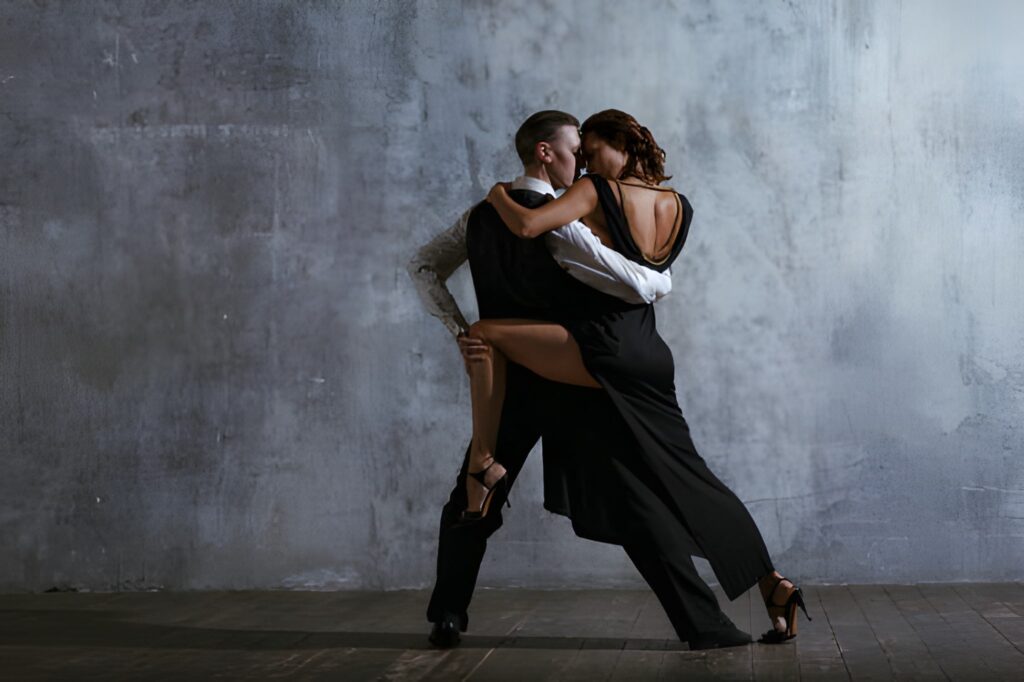
Every coach in the Arthur Murray organization is there for a reason – they possess the highest levels of dance knowledge and the ability to communicate that knowledge in a creative way to vast amounts of people.
Lola Volair embodies that definition perfectly, and takes it, pardon the pun, a step further.
She’s commonly referred to in the dance world as a legend. If you haven’t yet, at some point, you should have a coaching lesson with her to see for yourself. To help in that process, we interviewed her, so more Arthur Murray students can understand who she is, and where she came from. Lola Volair is truly one of the great mentors in the Arthur Murray world today, and the next time you see her – you’ll even know what she likes for breakfast.
Dance Legend Lola Volair: Why Dancing is Better Than Retirement

AM: What were the sequence of events that led you to Arthur Murray in the first place?
LV: Initially, I went to Arthur Murray’s for a very short time and took some lessons. Then I attended the University of British Columbia, where I joined the dance team with over 1500 members. We had great teachers and I took lessons there for a couple of years. From there, I got more interested in dancing and I inquired about becoming a teacher at Arthur Murray’s.
AM: When was the moment that you realized that Arthur Murray was it for you?
LV: I always knew it was where I belonged, but because of external pressures, it took me a long time to have the conviction to be there.
That’s a truth bomb right there. How many of us know exactly where we belong – but let “external pressures” convince us otherwise? In fact, Lola’s journey proves that finding your calling isn’t always a straight line. Sometimes it takes years to circle back to what you knew all along.
AM: What dance is the most fascinating to you?
LV: If I have great music, and a wonderful partner, I love slow foxtrot. English Rumba, American Cha-Cha – it all depends on the situation, the partner, and the place.
AM: OK, fill in the blank. “When I need to unwind I…”
LV: I do Pilates, I walk, and go out social dancing.
Notice that? She unwinds by going social dancing. When dance is your profession, your workout, and your relaxation activity – that’s not a job. That’s a lifestyle.
AM: Who plays the role of you in a Hollywood adaptation of your teaching life?
LV: (Gasp) No idea! I don’t watch movies very much. Bette Davis?
AM: (Laughs)
LV: No, my dream person would be Cyd Charisse.
AM: Oooh, Cyd Charisse.
LV: That would be my dream person, but would I be worthy of that? Never.
AM: What do you admire most about her?
LV: She was a person who moved effortlessly, but had fabulous training to look natural and organic.
The Secret to Great Dancing: Natural and Organic
AM: I know that you go to a lot of competitions, not only to judge professionals but also students. What’s the first thing you look at when you’re watching someone in a dance competition?
LV: Natural and Organic. Anything that we learn has to be so far into our cellular level that it has the feeling and appearance of natural and organic, not contrived.
This is gold for anyone preparing for a District Showcase or Dance-O-Rama. Judges aren’t looking for robotic perfection – they’re looking for dancing that appears effortless, even when it isn’t. That takes practice. Lots of it.
AM: What do you usually eat for breakfast?
LV: Oh that’s easy! If I’m at home, you really don’t want to know this, I have less than a half a cup of blueberries, the smallest banana I can find, kale (or some other deep green), pomegranate seeds. I add some sprouted seeds, liquid minerals, all the nutrients I can have for the day, in a smoothie – and add some hemp hearts. For my second course I have oatmeal with almond milk or quinoa with a salad.
AM: Sounds like a recipe for healthy living!
That breakfast routine might explain a few things about her legendary energy levels. When you’re traveling and coaching dancers across the country, you need fuel that works.
AM: As teachers, we focus a lot of time on technique. What’s a bit of technique that maybe we fuss about too much?
LV: I have to think. There can be no denying that cuban motion is important, but there is so much more to learning rhythm or latin dancing than just cuban motion. There’s rotation, there’s arm position, torque. We just get so immersed in cuban motion that everything else gets put aside and we don’t feel that organic movement of the dance.
In fact, this is advice every dancer needs to hear. Cuban motion matters – but obsessing over one element while ignoring everything else creates lopsided dancers. Balance in technique leads to balance on the floor.
AM: So what’s your comfort food? Like, something you eat on a rainy day?
LV: I try to pretend they don’t exist. I will say that potato chips are gone out of my life forever.
Why Dancing Beats Retirement
AM: How has Arthur Murray improved your health or well being?
LV: Oh my goodness! That’s why I’m here. I teach because it’s good for me as well as the students. I get the same benefits that the students get.
AM: Can you give an example?
LV: Every day I have such a positive view of the world. I have tried retirement, or been off of work for health reasons, and my life was not as happy. So, I am happier because I have the same benefits that a student has, the same sense of achievement, and the same sense of being in the now and being engaged – which is a very hard thing to achieve elsewhere.
Read that again. She tried retirement and her life was not as happy. This is coming from someone who could easily coast on decades of accomplishments. Instead, she chooses to keep teaching, keep traveling, and keep growing – because that’s what keeps her alive.
What does this mean for you? If you’re wondering whether dancing is “worth it” at your age – whether you’re 25 or 75 – Lola’s answer is clear. The benefits aren’t just physical. They’re mental, emotional, and deeply connected to purpose.
AM: How would you describe the difference in the Arthur Murray experience compared to everything else?
LV: Arthur Murray’s, our organization, makes a commitment to being inclusive, and not excluding people. So we are an “inclusive society” that puts people first. That creates, for me, a positive environment for the students, and that’s the most important thing.
The Lesson Behind the Legend
Lola Volair didn’t become a legend by accident. She became one by showing up – day after day, decade after decade – with a commitment to helping others grow. She found something that gave her life meaning, and she refused to let go of it.
The next time you’re on the fence about your dance program, remember this: a woman who could have retired years ago chooses not to – because dancing keeps her engaged, purposeful, and happy.
That’s not just good advice for dancers. That’s good advice for life.
Cyd Charisse photo credit: www.theredlist.com