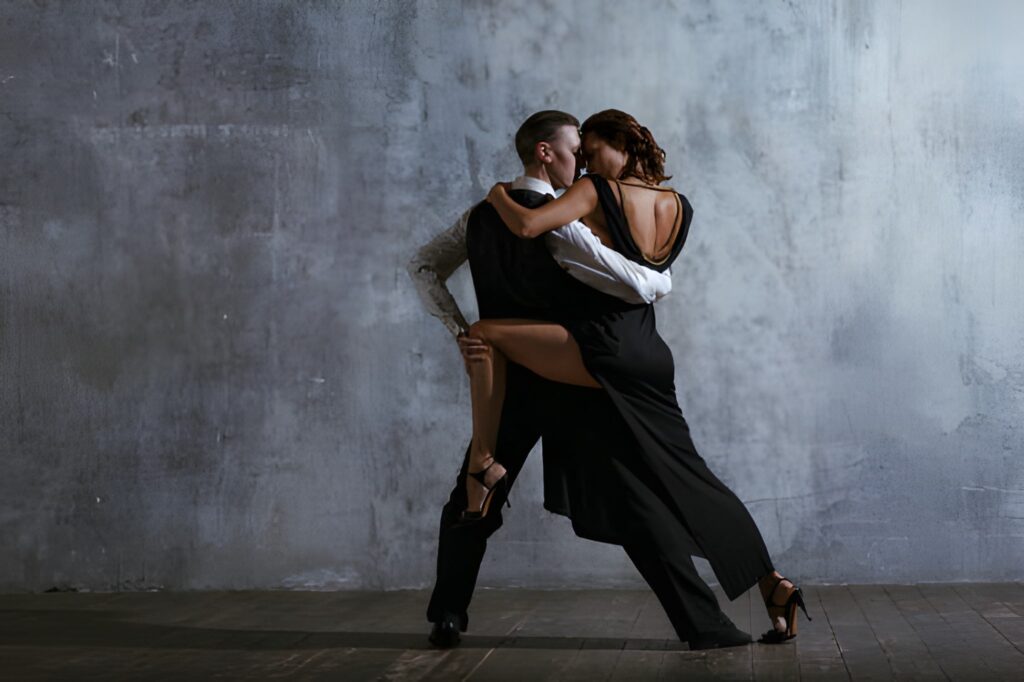
Dancing in a Puerto Rican Kitchen
Guest post by Bobby Gonzalez
Some of the best dance education doesn’t happen in a studio. It happens in a kitchen, with the stove still warm, the smell of sofrito in the air, and an aunt who refuses to let you sit down while the music is playing.
That’s where I learned the Merengue. Not from a textbook. Not from a video. From my family – in spaces barely big enough to turn around.
The Merengue: A Brief History
The Merengue comes from the Dominican Republic, where it developed in the early-to-mid 1800s. The exact origins are debated – some say it evolved from African rhythms brought by enslaved people, others point to European influences – but what everyone agrees on is this: It was designed to be accessible.
Why? Because the best social dances are the ones anyone can do. Merengue doesn’t require a lot of space. It doesn’t require years of training. It requires a partner, a beat, and the willingness to move.
In fact, the basic step is essentially a marching motion – left, right, left, right – with your hips doing most of the storytelling. That simplicity is what made it spread across the Caribbean and into Latin communities everywhere.
The Puerto Rican Kitchen Classroom
Growing up, family gatherings meant music. There was no avoiding it. The salsa records would start spinning before the food was even ready, and by the time dessert came around, the living room had become a dance floor.
But the real lessons happened in the kitchen.
My tía would be at the stove, stirring something that smelled incredible, and she’d grab my hand without warning. “Baila conmigo,” she’d say. Dance with me. And suddenly we were moving between the counter and the refrigerator, navigating around cousins and chairs, dancing in a space the size of a closet.
That’s the magic of Merengue – it works anywhere. Crowded nightclub? Perfect. Tiny kitchen? Also perfect. The dance adapts to its environment rather than demanding a ballroom.
What the Merengue Teaches You
There’s a reason many Arthur Murray instructors recommend Merengue as one of the first dances you learn. It develops skills that transfer to everything else:
Timing
Merengue moves on every beat. There’s no syncopation to confuse you, no “quick-quick-slow” to count. Just steady, consistent rhythm. Learn to feel that pulse and you’ve built the foundation for every other dance.
Cuban Motion
That hip movement you see in Latin dances? Merengue teaches it gently. Because the basic step is so simple, you have mental bandwidth to focus on how your body moves – not just where your feet go.
Leading and Following
In a kitchen-sized space, you learn to communicate with your partner through touch and intention. There’s nowhere to go if you’re not connected. The lead has to be clear. The follow has to be responsive. These skills become automatic.
Partner Awareness
Dancing in tight quarters teaches you to feel your partner – their balance, their timing, their readiness for the next turn. You can’t rely on visual cues when you’re navigating around a table.
The Cultural Connection
Dance was never separate from daily life in my family. It was woven into everything – celebrations, mournings, random Tuesday evenings when someone decided to put on a record.
That’s something we sometimes lose in formal dance education. We treat dancing like a skill to acquire rather than a way of being. But in cultures where dance is inherited, passed from generation to generation in living rooms and kitchens, it’s understood differently. Dancing isn’t something you do. It’s something you are.
I carry my tía’s lessons with me every time I step onto a floor. The rhythm she taught me. The connection she demonstrated. The joy she showed me that dancing could bring – even when (especially when) the space was too small and the music was too loud and the food was getting cold.
Bringing the Kitchen to the Studio
So how do you capture that kitchen energy in a formal lesson? A few thoughts:
Don’t wait for perfection
My tía never said “wait until you’re ready.” She just grabbed my hand and started moving. The learning happened in motion, not in preparation for motion.
Embrace small spaces
Practice in your living room. Practice in your kitchen (carefully). The constraint of limited space forces better technique – tighter turns, clearer leads, more precise footwork.
Make it social
Dance with different partners. Dance at parties. Dance when the music plays, whether or not you’ve “warmed up.” The point isn’t to perform. The point is to connect.
Try It Yourself
You don’t need to grow up in a Puerto Rican family to learn Merengue. You just need curiosity and a willingness to move.
Find a class. Find a partner. Find a kitchen, if that’s what you have. Put on some music and start with that simple marching step – left, right, left, right. Let your hips follow naturally. Don’t think too hard.
Whether you take your Merengue to the club or keep it in your kitchen, the dance will give you something valuable: rhythm, connection, and a memory you’ll carry forward.
That’s what dance does. It turns ordinary spaces into extraordinary moments. It takes the everyday – a kitchen, a gathering, a Tuesday evening – and transforms it into something worth remembering.
Just like my tía taught me.