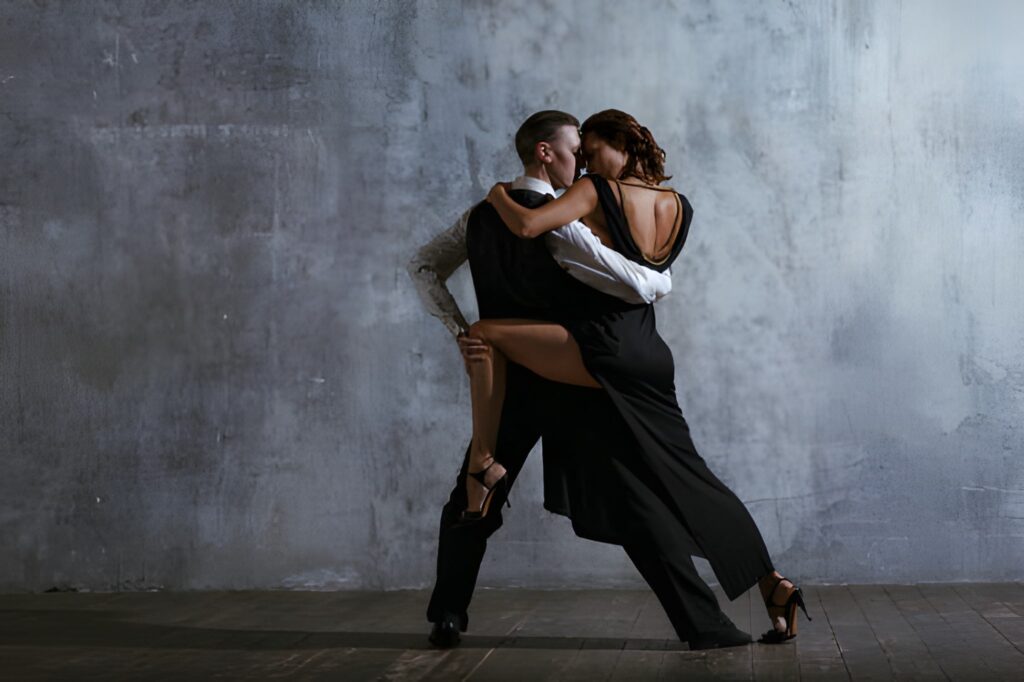
Master the art of eye contact in Salsa, Bachata, Rumba, and other Latin dances to enhance your connection without crossing comfort boundaries.
“How Much Eye Contact is Too Much in the Latin Dances?”
Imagine looking directly into a stranger’s eyes, and singing this song while dancing the Bachata:
“Every breath you take and every move you make
Every bond you break, every step you take, I’ll be watching you
Every single day and every word you say
Every game you play, every night you stay, I’ll be watching you”
Awkward!
There’s a reason we jokingly refer to the “I’ll Be Watching You” song by Sting as “The Stalker Song.”
Why Eye Contact Matters in Latin Dances
Let’s get caught up. Dances like Salsa, Bachata, Rumba, Bolero, Cha-Cha, Mambo, Merengue, Samba, and Zouk are considered “Latin Dances.” They can be suggestive, sensual, and in close proximity to your partner (and if you’ve seen the Bachata and Zouk, that’s pretty close). Because of these factors, these dances can quickly disrupt your comfort zone.
Too much eye contact can cause your comfort zone, and all those around you, to disappear entirely.
Understanding how to properly manage eye contact is an essential skill that separates awkward dancers from confident social dancers. The good news is that with the right guidance from your Arthur Murray instructors, you can master this subtle but important aspect of Latin dancing.
3 Reasons Why Eye Contact Can Feel Awkward in Latin Dances
1. They Are Sexy
These dances are designed to move your body in a way you’d never move at work (depending on your occupation). With an emphasis on Latin hip movement and body isolations, these dances don’t just look sexy, they feel sexy. This natural sensuality can make sustained eye contact feel more intense than in other dance styles.
2. You Are Close To Your Partner
Latin Dances like Salsa, Bachata, and Merengue are built for the nightclub, not a ballroom. A dance frame will always reflect the amount of space one has in their dance environment. A ballroom has a lot of space, so there’s a bigger frame. But a big frame at a Latin Dance nightclub could start a riot (or an angry stare). Because of this, you are physically closer to your partner with this style of dancing, making eye contact feel even more personal.
3. Moving as a Unit
Hip motion, a close dance frame, and body isolations are all sexy in their own right, but when a leader and follower have the ability to match those attributes, there’s a connection. It’s the dance equivalent of two singers harmonizing. This synchronization can intensify the experience of making eye contact with your partner.
3 Reasons Your Eye Contact Could Come Across Wrong
1. Where You’re Looking is Making Your Partner Uncomfortable
While it’s not direct eye contact per se, it’s better to look up above your partner’s head, over their shoulder, or directly at their face than, say, looking down. That could come across as “checking them out” even if that’s not the intention. Being mindful of where your gaze lands is crucial for making your dance partner feel respected and comfortable.
2. You’re Thinking
A blank stare is a common accessory to any new activity that requires a bit of brain power. The outside may show that you’re staring, but you may just be processing what move you’re doing next. This is completely normal, especially for newer dancers who are still building their muscle memory.
3. Talking and Dancing is New
This is definitely a symptom of the issue above, but talking while dancing takes time to develop, even for advanced dancers. The reason? Dancing is a form of non-verbal communication. So conversing can sometimes seem awkward or forced until it becomes a regular part of the social dancing repertoire.
Solution: Some of the best dances for training your “talking and dancing” skills are non-Latin dances like Foxtrot or Tango. These dances tend to move in the same direction, like driving down the highway, instead of Latin dances which are more like driving through a city with a lot of turns and stops.
Solutions To Prevent Awkward Eye Contact
There’s nothing wrong with eye contact. It’s like a firm handshake, or a proper greeting. With the right approach, it’s polite. But even a handshake can be too firm, and eye contact can go beyond polite. Here are some tips that can help in any dance environment.
1. Smiling
Smiling at your partner is a sign of friendliness and approval. Eye contact without a smile can be a mixed bag. When in doubt, dance, smile, and dance some more. A genuine smile transforms what might feel like an intense stare into a warm, inviting connection that your partner will appreciate.
2. Look Away Strategically
Let’s get something straight. We aren’t suggesting that you look away from your partner in favor of someone else in the room. Looking away can be part of the dance pattern you’re executing, or a means of scanning the room to avoid a collision. Doing this can make your turns look sharper, and your movements more definitive. The best Latin dancers know how to alternate between moments of connection and strategic looks away.
3. Practice Talking While Dancing
Talking while dancing is the basis for social dancing. Having a conversation makes eye contact less weird, more polite, and leaves less to the imagination. It takes time, but developing this skill is the best insurance policy to prevent long, awkward staring from occurring.
The best place to develop this skill is at an Arthur Murray Practice Party, where you can dance with multiple partners in a supportive environment and get comfortable with the natural give-and-take of eye contact and conversation.
Building Your Eye Contact Confidence
Start in Group Classes
Group classes at Arthur Murray provide a perfect low-pressure environment to work on your eye contact skills. You’ll rotate between partners, giving you the opportunity to practice appropriate eye contact with different people. This variety helps you develop a natural, comfortable approach that works across different dance situations.
Reinforce at Practice Parties
Practice Parties are the ideal setting to take your eye contact skills from the lesson room to the social dance floor. With music playing and fellow students dancing, you can experiment with different levels of eye contact and find what feels natural and comfortable for you.
Work With Your Instructor
Your Arthur Murray instructor can provide personalized feedback on your eye contact. They can help you identify habits you might not be aware of and give you specific techniques to improve your connection with dance partners.
Final Thought
Pick your spots. There are times when you need to bring out the fine china, and others where that would be overkill (say, at a BBQ). The same can be said for performance dancing versus social dancing. You see, eye contact is usually only a problem when someone is in “performance mode” instead of “social dance mode.”
Whether it’s eye contact, arm styling, or facial expressions, you’ve got to pick your spots. The old saying is that the eyes are an invitation to the soul, so just make sure you’re inviting them to the right kind of party.
Remember, mastering eye contact in Latin dances is a journey, not a destination. With regular practice at your local Arthur Murray studio, attending Practice Parties, and working closely with your instructors, you’ll develop the confidence to connect with any dance partner through the perfect balance of eye contact.
Frequently Asked Questions
How long should I maintain eye contact while dancing Latin dances?
There’s no set rule for duration. The key is to alternate between making eye contact and looking away naturally. A few seconds of eye contact followed by a look to the side or over your partner’s shoulder creates a comfortable rhythm. Your Arthur Murray instructor can help you find what feels natural during your private lessons.
Is it okay to avoid eye contact completely while dancing?
While avoiding eye contact entirely might feel safer, it can make the dance feel disconnected. Instead, aim for brief moments of eye contact, especially during turns and moments of connection. Completely avoiding eye contact may signal disinterest or discomfort to your partner.
How do I handle eye contact with a stranger at a social dance event?
Start with a friendly smile when you ask someone to dance. During the dance, use the techniques described above: smile, look away during turns, and try light conversation. Practice Parties at Arthur Murray are excellent for building comfort with dancing with different partners.
What if my partner’s eye contact makes me uncomfortable?
It’s okay to look at their forehead, over their shoulder, or focus on your technique. You can also initiate light conversation, which naturally reduces the intensity of sustained eye contact. If you’re consistently uncomfortable, mention it to your Arthur Murray instructor who can help you develop strategies.
Does eye contact differ between different Latin dances?
Yes, the intensity and frequency of eye contact can vary. More intimate dances like Bachata and Bolero often feature more sustained connection, while faster dances like Salsa and Merengue naturally include more moments of looking away during spins and turns. Group Classes at Arthur Murray will help you understand the nuances of each dance.