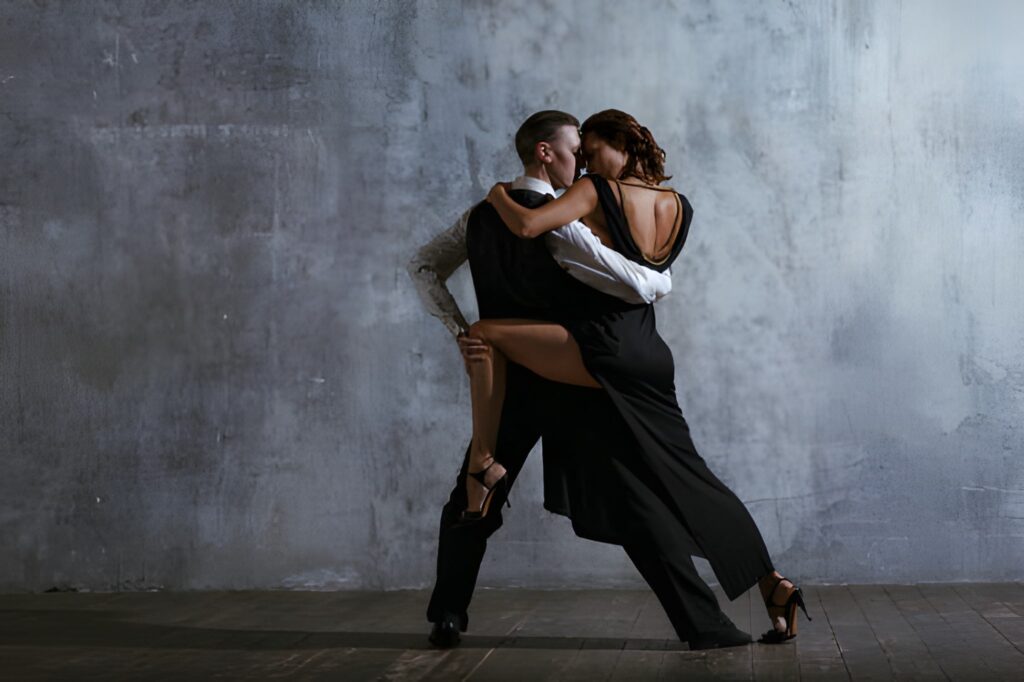
You’re about to step onto a competition floor in front of judges, spectators, and – let’s be honest – your own expectations. Your heart rate spikes. Your palms get sweaty. That voice in your head starts whispering, “What if I forget everything?”
Here’s the thing: Navy SEALs face life-or-death situations where panic could be fatal. And yet, they perform with remarkable calm under pressure. The secret? They don’t hope their nerves go away. They train themselves to manage them.
What if you could bring that same tactical mindset to your next dance competition?
Why Your Brain Works Against You (And What to Do About It)
When stress hits, your brain’s amygdala – the alarm system – takes over. It’s designed to protect you from threats by flooding your body with adrenaline, increasing your heart rate, and narrowing your focus. Great for escaping a predator. Not so great for remembering your Waltz choreography.
In fact, this stress response is why even experienced dancers sometimes “blank out” during performances. Your brain is literally in survival mode, not performance mode.
Navy SEALs understand this biology – and they’ve developed specific techniques to override it. The good news? These same techniques work for dancers. You don’t need to crawl through mud to use them (although that would make for an interesting pre-showcase warmup).
Technique #1: Box Breathing (The 4x4x4x4 Method)
This is the signature SEAL breathing technique, and it’s exactly what it sounds like – a four-sided approach to controlling your breath and, by extension, your nervous system.
Here’s how it works:
- Inhale for 4 seconds – Draw breath in slowly and deeply through your nose
- Hold for 4 seconds – Keep the air in your lungs, stay relaxed
- Exhale for 4 seconds – Release slowly through your mouth
- Hold for 4 seconds – Stay empty before repeating
Why does this work? When you control your exhale, you activate your parasympathetic nervous system – the “rest and digest” mode that counteracts the fight-or-flight response. A study published in the Journal Frontiers in Human Neuroscience found that slow, controlled breathing significantly reduces anxiety and improves focus.
Pro Tip: Practice Box Breathing during your regular dance lessons – not just before competitions. The more you practice in low-stakes environments, the more automatic it becomes when the pressure’s on.
When to Use Box Breathing
- In the holding area before your heat is called
- While waiting for the music to start
- Between rounds when you feel your heart racing
- Anytime your comfort zone voice starts telling you to panic
Technique #2: Visualization (The Mental Rehearsal)
SEALs don’t just physically rehearse missions – they mentally rehearse them. Over and over. They visualize every step, every decision point, every possible complication. By the time they execute the actual mission, their brains have already “been there” hundreds of times.
How does this translate to dance competition? Instead of just marking through your routines, you should be running them in your mind with vivid detail.
The SEAL Visualization Protocol for Dancers
Step 1: Set the Scene
Close your eyes. Picture the exact competition floor – the lighting, the judges’ table, the music coming through the speakers. Make it as real as possible. Where are you standing? What are you wearing? What does the floor feel like under your shoes?
Step 2: Run the Performance
Visualize yourself dancing your entire routine. Not just the steps – the quality of movement, your frame, your expression, your connection with your partner. Feel the music. Experience the transitions between figures.
Step 3: Include the Pressure
Here’s where most people miss the mark. Don’t just visualize a perfect, stress-free performance. Visualize the nerves, the judges watching, the moment where you typically tense up – and then visualize yourself handling it. See yourself staying calm, staying present, dancing through it.
Step 4: End with Success
Finish your visualization with your final pose, the applause, and – most importantly – the feeling of having executed your best performance. Your brain doesn’t fully distinguish between vividly imagined experiences and real ones, which is why visualization is so powerful.
In fact, research from the National Institutes of Health confirms that mental practice activates many of the same neural pathways as physical practice – meaning visualization literally makes your brain better at the task.
Technique #3: Arousal Control (Finding Your Optimal Zone)
There’s a concept in performance psychology called the Yerkes-Dodson Law – a fancy way of saying there’s a sweet spot for stress. Too relaxed, and you’re not sharp enough. Too stressed, and you fall apart.
Navy SEALs train to find their optimal arousal level for different tasks. A sniper needs a different level of intensity than someone clearing a room. Similarly, a Waltz requires different energy than a Jive.
How do you find your zone? Start by paying attention to how you feel during your best performances. Were you nervous but excited? Calm but focused? Slightly on edge? That’s your target state.
If you’re too amped up before a competition, use Box Breathing to bring yourself down. If you’re too flat, use energizing techniques – a quick physical warmup, pumping music, or even positive self-talk to get your energy up.
Technique #4: Trigger Words and Phrases
SEALs use specific words or phrases to refocus during high-stress moments. These triggers are personal and meaningful – a word or phrase that immediately snaps them back to their training and purpose.
What’s your trigger word? It might be:
- “Breathe” – A simple reminder to stay present
- “Trust” – Trust your training, trust your body, trust your partner
- “Dance” – Not “perform,” not “compete” – just dance
- “I’ve done this” – A reminder that you’ve practiced this moment
The key is choosing a word that resonates with you and practicing using it. Your trigger word should become automatic – something you deploy without thinking when your mind starts racing.
Technique #5: The Pre-Performance Routine
SEALs have meticulous pre-mission routines. Every step is deliberate. The routine itself becomes calming because it’s familiar – a series of actions that signal to the brain, “We’ve been here before. We know what comes next.”
Your pre-competition routine should work the same way. What do you do in the hour before you compete? The 30 minutes? The final 5 minutes?
Building Your Pre-Competition Routine
The Hour Before:
- Physical warmup (nothing strenuous, just get your body moving)
- Review your routines mentally (not frantically – calmly)
- Connect with your teacher or partner
The 30 Minutes Before:
- Box Breathing session (2-3 minutes)
- Visualization of your first dance
- Light movement to stay loose
The Final 5 Minutes:
- Trigger word reminder
- One last deep breath
- Focus on your opening – nothing else
Pro Tip: Practice your pre-competition routine before every major event – showcases, medal tests, Group Classes with social dancing. The routine should become so familiar that it actually triggers calmness.
The Mental Shift: From Threat to Challenge
Here’s something Navy SEALs understand that many competitors miss: The goal isn’t to eliminate stress. It’s to reframe it.
When your brain perceives a competition as a threat, it triggers anxiety. When it perceives the same situation as a challenge, it triggers focus and energy. Same physiological response – completely different mental experience.
How do you make the shift? By changing your internal narrative.
- Instead of “I have to perform perfectly,” try “I get to show what I’ve learned”
- Instead of “Everyone is watching me,” try “I’ve prepared for this moment”
- Instead of “What if I fail?” try “This is my opportunity to grow”
This isn’t just positive thinking – it’s strategic framing. And it works.
Putting It All Together: Your Competition Day Game Plan
Let’s map out how a Navy SEAL-inspired approach might look for your next competition:
The Night Before:
Visualize your routines. Not anxiously – calmly, confidently. Go through each dance in your mind, including the pressure moments. Then get a good night’s sleep (your brain consolidates learning during sleep, so this is actually productive).
Competition Morning:
Run through your pre-competition routine. Box Breathing while getting ready. Positive self-talk. Remind yourself why you do this – not to prove something, but because you love dancing.
At the Event:
Stick to your routine. Don’t let the chaos of a competition venue throw you off. If you feel anxiety rising, pause and deploy Box Breathing. Use your trigger word to refocus.
Before Each Dance:
One final visualization. One final deep breath. Focus only on your opening – not the whole routine, just the first few counts. Your body knows the rest.
During the Dance:
If your mind wanders to anxiety, use your trigger word to bring it back. If you make a mistake, let it go – SEALs don’t dwell on errors mid-mission. Stay present, stay focused, keep dancing.
The Bigger Picture: Training Your Mind Like You Train Your Body
Here’s the thing about all these techniques – they only work if you practice them. Navy SEALs don’t learn Box Breathing the night before a mission. They train it for months, years, until it becomes automatic.
The same principle applies to you. Start using these techniques now – in lessons, at Practice Parties, during Group Classes. Make them part of your regular training, not just a competition-day Hail Mary.
In fact, the dancers who handle competition pressure best are usually the ones who’ve practiced handling pressure all along. They’ve trained their minds as deliberately as they’ve trained their feet.
Your Mission, Should You Choose to Accept It
You don’t need to become a Navy SEAL to perform under pressure. You just need to borrow their playbook – and commit to using it.
Start with Box Breathing. Add visualization. Build your pre-performance routine. Find your trigger word. And most importantly, practice all of it before you need it.
Your comfort zone voice will tell you this is overkill – that you should just “relax” or “not think about it.” But here’s the reality: Not thinking about it rarely works. Trained thinking does.
The competition floor is your arena. With the right mental preparation, you can walk onto it with the same controlled calm that SEALs bring to their missions.
Your turn. Ready to train like a SEAL?
For more competition preparation tips, check out our complete guide on what to expect at your first dance competition, and learn about recognizing your dance progress as you develop both your physical and mental skills.