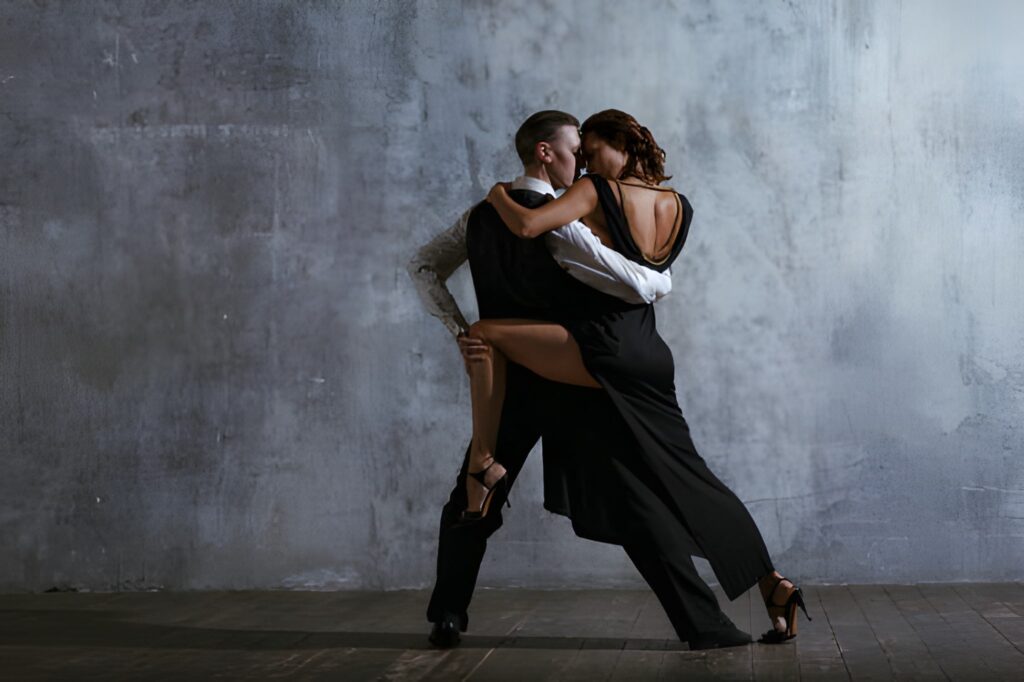
Master these 5 professional social dances perfect for office parties and work events. Learn which dances to avoid and which ones will impress your colleagues without risking your career.
It’s office party season, and with that comes everything from sly looks towards the community copy machine to occasional drunken rants that are later spoken of in hushed, HR-is-listening tones. The annual company celebration can be a minefield of professional and personal challenges, but it doesn’t have to be.
This is the part of the article where we urge you to take social dance lessons, explaining how it will land you that promotion, lower your bar tab, and change your placement in the company hierarchy. This may all be true, but there’s an inconvenient truth in all of this:
You might also enjoy: Things You Don’t Need to Learn Social Dancing
You might also enjoy: Tips for Finding Love Through Social Dance
You might also enjoy: Become A Successful Social Dancer in 17 Steps
Dancing can be risky at an office party.
However, the right dances, performed with taste and skill, can transform you from wallflower to workplace legend. Let’s explore five work-friendly social dances that will keep your reputation intact while showcasing your sophistication.
5 Work-Friendly Social Dances That Won’t Get You Fired
The key to successful office party dancing is choosing dances that are impressive yet appropriate. You want to stand out for your skills, not become the subject of Monday morning gossip. Here’s your complete guide to navigating the dance floor at any professional event.
Dance to Avoid: Dirty Dancing
As buzzworthy as it would be to see a mid-level manager knee-sliding into the party like Patrick Swayze, getting your Dirty Dancing grind-on will have you sliding through a never-before-seen trap door to Human Resources. The passionate, close-contact nature of this style might work in a nightclub, but it has no place at a company function.
Dance to Try Instead: Rumba
The Rumba is the sophisticated answer to inappropriate slow dancing. This elegant dance can be customized to your audience. Dialed down, you can dance the Rumba in a way that would be safe for your boss or your mother. For more romantically interested partners outside of work, you can dial up the intensity accordingly.
Why Rumba Works for Office Parties:
- Elegant and refined appearance that projects professionalism
- Customizable intensity depending on your dance partner
- Perfect for slow music commonly played at corporate events
- Replaces awkward swaying with actual structure and movement
- Creates conversation opportunities while dancing
Music to Use Rumba With:
Slow music is your target here. Think of this as the permanent replacement for the high school slow dance, bear hug, sad sway of misery. Rumba is the upgrade that adds structure, class, and a tempo comfortable enough to carry on the conversation of your choosing.
Song Examples: “Quizas, Quizas, Quizas” by Celia Cruz, “Sway” by Dean Martin, “Quando” by Michael Buble
The beauty of Rumba is that it allows you to maintain appropriate distance while still looking graceful on the dance floor. It’s the perfect dance for dancing with colleagues, supervisors, or clients.
Dance to Avoid: Cha Cha (For Beginners with Non-Dancers)
This is not an indictment on Cha Cha dancing and everything it has to offer, but as a first impression with a novice dancer, this may be more trouble than it’s worth. True, Cha Cha is a great social dance to know, but it does require some dance experience to be enjoyed by both partners.
The last thing you want is to out-dance, confuse, or frustrate someone as important as your boss, your colleague, or your date. Making your dance partner feel inadequate is never a good career move.
Note: If you are dancing with an experienced social dancer, Cha Cha is an absolute win on the dance floor. Just gauge your partner’s skill level first.
Dance to Try Instead: Merengue
If you’re looking for a nice and easy alternative to Cha Cha, Merengue is the dance for you. Merengue is a dance that even non-dancers can pick up and start using almost immediately. The sooner you get things up and moving, the sooner you separate yourself from the crowd of non-dancers at the bar.
Why Merengue is Office Party Gold:
- Incredibly easy to learn, even for absolute beginners
- No complex footwork to master before you can dance
- Quick upload time. Anyone can follow along
- High energy without being inappropriate
- Works with a wide variety of music
Music to Use Merengue With:
Upbeat music works perfectly with Merengue. This includes everything from what you’d expect on a cruise or at a Salsa club to bass-pumping electronic dance music where most people usually stand around and gyrate. Merengue gives you something to actually do with that music.
Song Examples: “Suavemente” by Elvis Crespo, “Conga” by Gloria Estefan, “Satisfaction” by Benny Benassi
The simplicity of Merengue means you can make anyone look good on the dance floor, which is exactly the impression you want to leave at a work event.
Dance to Avoid: Anything Miley Cyrus Has Ever Done
Sometimes all it takes is a little shindig to reveal the wild cage dancer in someone. We strongly encourage you, for employment’s sake, that you don’t consider your office party as that type of shindig. What happens at the company holiday party does not stay at the company holiday party. It follows you to every meeting, review, and coffee break for years to come.
Dance to Try Instead: Swing
The Swing is an all-purpose party dance that is as versatile as a great pair of jeans. Whether the DJ is playing Rock, Pop, or R&B, Swing says you’re both fun but with that old-school sophistication. All the “Party in the USA” Miley vibes you may feel can be easily replaced with this all-American fun dance.
Why Swing is Perfect for Professional Events:
- Projects confidence and competence without being showy
- Works with almost any upbeat music
- Classic, timeless appearance
- Energetic but appropriate
- Showcases personality while maintaining professionalism
Music to Use Swing With:
Swing fits everything from Springsteen to Elvis, Louis Jordan to Louis Prima. This dance style works with every genre of party music since dance parties started, including jazz, rock, and contemporary dance music.
Song Examples: “I’m Just a Gigolo” by Louis Prima, “Black and Gold” by Sam Sparro, “Hound Dog” by Elvis Presley
Learning Swing at Group Classes is a great way to prepare for office party season. The structured environment allows you to practice with multiple partners, building the versatility you’ll need at work events.
Dance to Avoid: Drunken Salsa-ish “Dancing”
Insert any popular nightclub dance, add an “-ish” to the end, and you’ve got a way of explaining someone’s alcohol-induced poor dance decision-making. Social dancing, like Salsa, isn’t something you can watch once and reproduce like, say, the robot. But let’s be honest, even the robot can be “robot-ish” with enough booze.
The “fake it till you make it” approach to dancing at office parties is a recipe for embarrassment. Your boss doesn’t want to dance with someone who’s just pretending to know what they’re doing.
Dance to Try Instead: Salsa (The Real Thing)
Learning actual Salsa looks and feels a lot better than pretending you’ve seen someone do it in a movie. Your boss doesn’t want to dance with someone who’s faking expertise, just like they wouldn’t want to work with someone who got their job by pretending to have qualifications they don’t possess.
Take some lessons, and do it the right way. Boss or no boss, you owe it to yourself not to be “Salsa-ish.”
Why Proper Salsa Training Matters:
- Genuine skill impresses more than confident faking
- Proper technique prevents injuries and embarrassment
- Real knowledge allows you to adapt to different partners
- Confidence comes from competence, not alcohol
- Skills transfer to multiple dance situations
Song Examples: “Ran Kan Kan” by Tito Puente, “Vivir Mi Vida” by Marc Anthony, “El Cantante” by Hector Lavoe
Attending Practice Parties is an excellent way to develop your Salsa skills in a social setting before bringing them to the office party.
Dance to Avoid: Quickstep
So, let’s say you do take dance lessons. Maybe you’re even a competitive dancer. But let’s get one thing straight: Unless you happen to work on a little TV show called ABC’s Dancing with the Stars, there’s no room for Quickstep at your office party, with or without your boss hanging on for dear life.
The Quickstep, while impressive in competition, requires too much floor space, too much speed, and too much technical precision for a typical office party environment. Save it for the ballroom.
Dance to Try Instead: Foxtrot
Simply put, the Foxtrot is the Swiss Army knife dance for weddings and office parties. It’s slow enough to engage in a conversation about the nuances of that second quarter keynote your boss executed, all while cruising comfortably around the dance floor to a variety of swanky music.
Why Foxtrot is Your Go-To Professional Dance:
- Elegant enough for executive events
- Slow enough to maintain conversation
- Works on crowded floors without requiring much space
- Timeless sophistication that never goes out of style
- Easy to maintain proper professional distance
Music to Use Foxtrot With:
In many office party environments, there’s mood music, thumping party music, and holiday music, depending on the time of year. Plan on deploying your Foxtrot during any swanky mood music. This is also a great way to ensure plenty more room on the dance floor, as non-dancers typically sit these songs out.
Song Examples: “Mack the Knife” by Bobby Darin, “Fly Me To the Moon” by Frank Sinatra, “L-O-V-E” by Nat King Cole
The Foxtrot positions you as someone with class and culture, exactly the image you want to project in professional settings.
Most Importantly: Choose to Dance
Aside from the particulars and the do’s and don’ts of social dancing at an office party, the most important factor to remember is, plain and simply, dancing.
The biggest, most perplexing dance problem for most people isn’t “which dance should I do to this song?” It’s usually “Do I have to dance at this party?”
For those who haven’t learned how to dance: Dance situations always seem to pop up like some unwanted work evaluation. They’re dreaded, avoided, and often result in awkward moments that linger in memory.
For those who have learned how to dance: They seek out dancing. They hunt for it. It’s the employee who’s done stellar work and is looking forward to that company review. Dancing becomes an opportunity rather than an obligation.
If there is one singular nugget of information you take from this article, choose dancing. Choose to be the person who looks forward to the dance floor rather than dreading it.
Building Your Dance Skills Before the Next Party
The best time to prepare for your next office party is now. Here’s how to build the skills that will serve you at every professional event:
Take Private Lessons
Work one-on-one with a professional instructor to learn the fundamentals of each dance style. Private lessons allow you to focus on the specific dances you’ll use most at office events.
Attend Group Classes
Group Classes give you the opportunity to practice with multiple partners, building the adaptability you’ll need when dancing with colleagues of varying skill levels.
Practice at Studio Events
Practice Parties provide a social environment where you can apply your skills with different partners. This is the closest experience to an actual office party you can get while still in a learning environment.
Start Early
Don’t wait until the week before your company party to start lessons. Building genuine skill takes time, and you’ll want to feel confident, not cramped, when you hit the dance floor.
Final Thought
This information does not guarantee that bosses like Elon Musk, Gary Vaynerchuk, or Mark Cuban will agree to dance with you, give you a promotion, or let you hold the clicker in their next PowerPoint.
However, this is hopefully the start of office parties, wedding receptions, and dance-related events you can seek out and look forward to. Dancing transforms these occasions from obligations into opportunities.
A goal is just future regret until you take action. We hope this article inspired you to do just that. Spend 45 minutes of your time in a dance lesson, and we know you’ll discover something that will positively impact your life, professionally and personally.
Frequently Asked Questions
What’s the safest dance to do at an office party?
The Foxtrot is generally considered the safest and most appropriate dance for professional settings. It’s elegant, allows for conversation, and maintains proper distance between partners.
Can I learn to dance well enough for office parties in a short time?
Yes! Dances like Merengue and basic Swing can be learned quickly. With a few private lessons and some practice at studio Group Classes and Practice Parties, you can develop solid skills within weeks.
How do I ask a colleague to dance without it being awkward?
Approach it professionally and casually. A simple “Would you like to dance?” with a friendly smile works perfectly. If they decline, accept gracefully and move on. No pressure.
Should I drink before dancing at work events?
Moderation is key. A drink or two might calm nerves, but too much alcohol leads to poor decision-making on the dance floor, exactly what you’re trying to avoid.
What if my boss is a terrible dancer?
Make them look good. Lead or follow in a way that’s easy to follow or clear to lead. The Merengue is great for this because even novice dancers can pick it up quickly.
How can I practice for office parties between dance lessons?
Attend Practice Parties at your local Arthur Murray studio. These events simulate social dancing situations perfectly and give you experience dancing with different partners.
Ready to prepare for your next office party? Contact your local Arthur Murray Dance Studio to start building the dance skills that will serve you throughout your professional life.