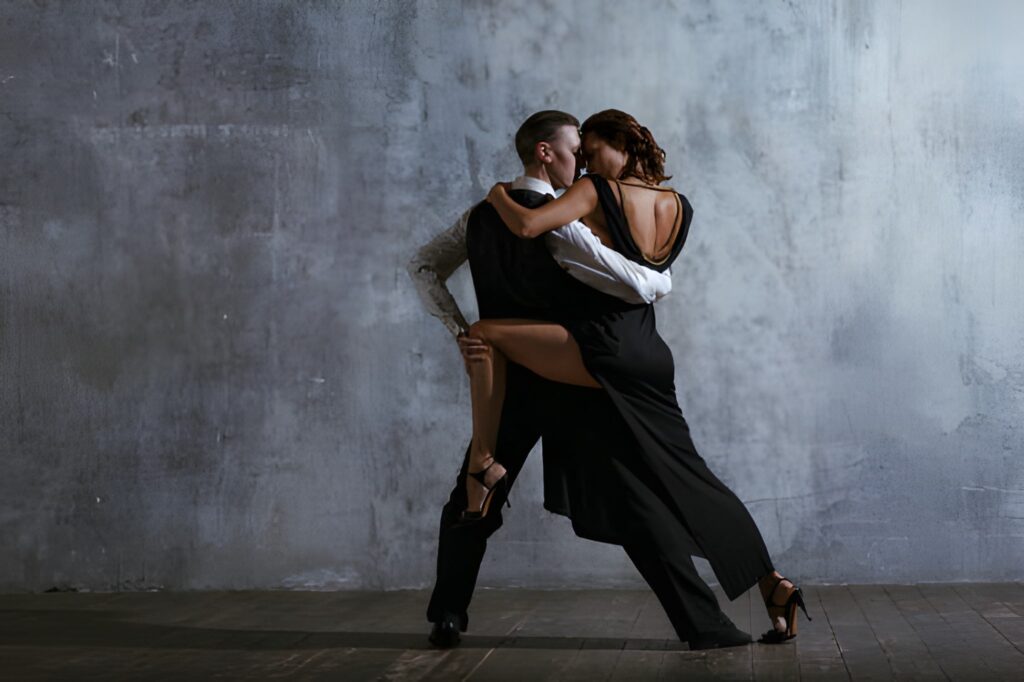
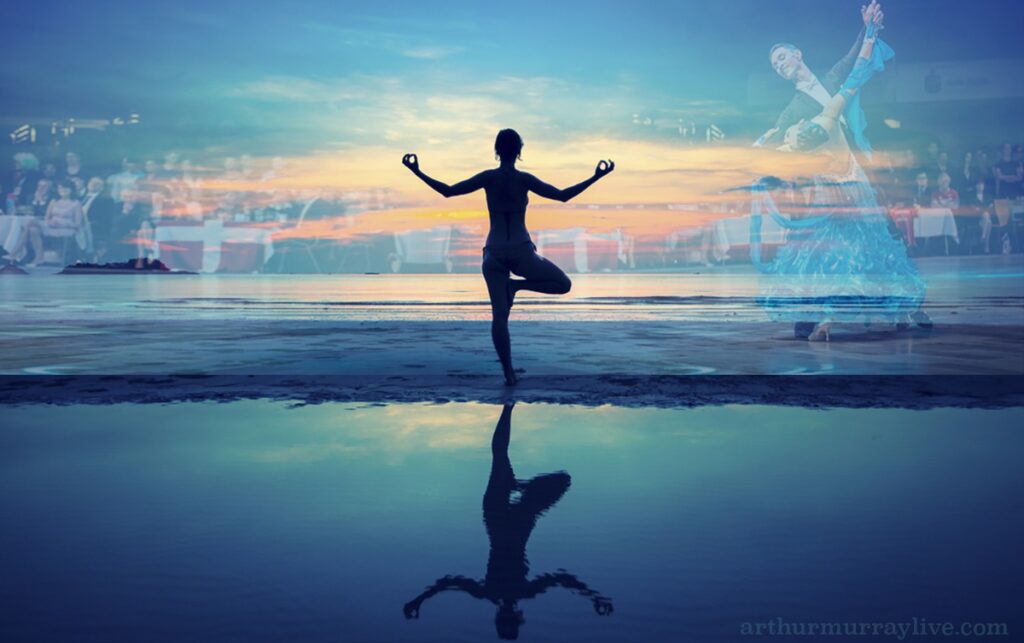
These yoga poses for ballroom dancers take just 15 minutes daily. Working hand in hand with your dance program, they’ll put your learning on hyperdrive.
If you’ve taken more than a handful of dance lessons, you’ve probably heard your instructor say something like, “Stand up straighter,” “Lift your chest,” or “Engage your core.” Over time… sometimes without even realizing it… you start to internalize these reminders. Your posture improves not just on the dance floor, but in everyday life. People notice. You feel more confident.
But what if there was a way to accelerate this transformation? What if you could develop the posture, balance, flexibility, and body awareness that great dancing requires—faster and more effectively?
The answer lies in yoga.
Why Yoga Poses for Ballroom Dancers Work
Before diving into the specific poses, it’s worth understanding why these two disciplines complement each other so well.
Shared Emphasis on Posture: Both yoga and ballroom dancing require maintaining proper spinal alignment while moving through space. The awareness you develop in yoga translates directly to your dance frame.
Balance as Foundation: Every turn, pivot, and weight transfer in dancing tests your equilibrium. Yoga systematically develops the proprioception (body position awareness) that makes these movements feel natural. Research published in the National Library of Medicine confirms that yoga meditation significantly improves proprioception and balance function.
Flexibility for Expression: Stiff muscles limit your range of motion and make movements appear forced. Yoga lengthens muscles gradually and safely, allowing for fuller, more expressive dancing. According to Harvard Health, yoga postures help reduce muscular tension, build flexibility and strength, and improve balance.
Breath Control: Proper breathing supports sustained energy and fluid movement in both practices. Yoga teaches breath patterns that enhance any physical performance.
Mind-Body Connection: The focused attention yoga requires… being present in each moment and each movement… directly supports the concentration needed for learning and executing dance patterns. A randomized controlled trial from NIH demonstrated that yoga significantly improves both balance and flexibility.
The 10 Essential Yoga Poses for Ballroom Dancers
Pose 1: Mountain Pose (Tadasana)
Benefits: Posture, stability, groundedness
Mountain pose may look like simply standing still, but it’s actually the foundation for all standing yoga poses and for proper ballroom posture.
How to Practice: Stand with your feet hip-width apart, weight evenly distributed across both feet. Tuck your tailbone slightly under, aligning your hips directly over your ankles. Feel the natural curves of your spine while lengthening upward through the crown of your head. Your spine should feel long and straight, reaching toward the ceiling.
Roll your shoulders back and down, away from your ears. Let your arms hang naturally at your sides with palms facing forward or toward your thighs. Engage your thigh muscles without locking your knees.
Hold this position for 4-8 slow, deep breaths.
Dance Application: This pose teaches the vertical alignment that creates a strong dance frame. The awareness of weight distribution prepares you for smooth weight transfers during dancing. Practice mountain pose before every lesson and notice how naturally you find proper posture.
Pose 2: Staff Pose (Dandasana)
Benefits: Posture, core strength
Staff pose builds the core strength essential for controlled movement while teaching you to find and maintain your center of balance.
How to Practice: Sit on the floor with your legs extended straight in front of you. Position your hands on the floor just behind your hips, fingers pointing toward your feet. Press your hip bones down into the floor while simultaneously reaching your head upward to lengthen your spine.
Drop your shoulders back and down. Flex your feet, pressing through your heels while pulling your toes back toward your head. Engage your quadriceps to straighten your legs fully.
Hold for 4-8 breaths.
Dance Application: In dancing, your center determines the quality of every turn and weight transfer. This pose helps you identify exactly where your center of balance lives and how to maintain it while moving.
Pose 3: Balancing Table Pose (Dandayamana Bharmanasana)
Benefits: Balance, Contra Body Movement (CBM) coordination
This pose develops the coordination between upper and lower body that smooth ballroom dancing requires. It specifically trains the opposite-arm-to-leg coordination that appears in many dance figures.
How to Practice: Begin on your hands and knees in tabletop position, with wrists directly under shoulders and knees under hips. Keep your spine neutral, not arched or rounded.
On an inhale, extend your right leg straight back, parallel to the floor, while simultaneously extending your left arm forward. Keep your hips level and your core engaged. Avoid letting your lower back sag or your hips rotate.
Hold for 3-6 breaths, then release and repeat on the opposite side (left leg, right arm).
Dance Application: CBM (Contra Body Movement) is fundamental to ballroom dancing. This pose trains your body to coordinate opposite limbs smoothly, which translates to more natural-looking dance movement.
Pose 4: Cat/Cow Pose (Marjaryasana-Bitilasana)
Benefits: Chest and core flexibility, posture awareness
This flowing sequence increases spinal mobility and opens the chest. Both are essential for maintaining a beautiful dance frame.
How to Practice: Start in tabletop position on hands and knees. On an inhale, arch your spine, reaching your tailbone upward while letting your belly drop toward the floor and lifting your gaze toward the ceiling (cow pose).
On an exhale, round your back toward the ceiling, tuck your tailbone under, and look toward your navel (cat pose).
Flow between these two positions slowly, matching movement to breath. Repeat 10 times.
Dance Application: The opening through your chest improves your frame in smooth dances like Waltz and Foxtrot, while the spinal mobility aids Latin hip motion. The awareness of how your spine can move helps you isolate and control different parts of your body while dancing.
Pose 5: Downward-Facing Dog (Adho Mukha Svanasana)
Benefits: Strengthening lats, stretching calves and hamstrings
Downward dog is one of yoga’s most recognizable poses and offers tremendous benefits for dancers.
How to Practice: From tabletop position, tuck your toes and lift your hips up and back toward the ceiling, using straight arms. Your body should form an inverted V shape.
Press your hips back toward your thighs while keeping your spine straight. Don’t round your back. Work on pressing your heels toward the floor (they don’t need to touch). Keep your head between your upper arms, ears in line with biceps.
Hold for 4-8 breaths.
Dance Application: Strong lat muscles support your frame, particularly important in smooth dances where you maintain connection with your partner throughout extended movements. Flexible hamstrings and calves allow for deeper lunges and better Latin hip action.
Pose 6: Tree Pose (Vrksasana)
Benefits: Balance, groundedness, weight awareness
Tree pose challenges your balance in ways that directly translate to dance turns and pivots. If you’re preparing for your first competition, this pose is essential.
How to Practice: From standing (mountain pose), bend your right knee and shift your weight fully onto your left leg. Place the sole of your right foot against your left inner leg, either on your inner thigh or your calf. Never place your foot against your knee joint.
Once balanced, lift your arms overhead in an H position (arms parallel, shoulder-width apart). Find a fixed point to gaze at (a “drishti”) to help maintain balance.
Hold for 4-8 breaths, then repeat on the other side.
Dance Application: The focused attention required in tree pose mirrors the concentration needed during complex dance sequences. The awareness of grounding through one foot while maintaining lift through your body translates directly to every pivot and turn in ballroom dancing.
Pose 7: Awkward Pose (Utkatasana)
Benefits: Ankle strength, calf strength, balance
Also known as Chair Pose, this challenging posture builds the lower leg strength essential for dancing.
How to Practice: From standing, bend your knees into a squat position as if you’re about to sit on the edge of a chair. For the dancer-specific variation, lift your heels high off the floor, balancing on the balls of your feet.
Extend your arms forward, parallel to the floor, palms facing down. Keep your core engaged and your back as straight as possible.
Hold for 3-6 breaths.
Dance Application: Strong ankles and calves provide the stability needed for pivots, heel leads, and sustained movement across the floor. This pose specifically targets the muscles that support you during rises and relevés common in many ballroom dances.
Pose 8: Low Lunge and Half Monkey Pose
Benefits: Leg flexibility, hip flexor opening, lower body strengthening
These complementary poses target the hip flexors and hamstrings that enable expressive leg movement.
How to Practice: From tabletop position, step your right foot forward between your hands, positioning your knee directly over your ankle. Lower your back knee to the floor. On an inhale, lift your head toward the ceiling, lengthening through your spine.
Hold this low lunge for two breaths.
Then, release your hips back, peeling your front foot onto your heel (toes pointing up). Lower your chest toward your front knee, keeping your spine long.
Repeat this sequence four times on each side.
Dance Application: Flexible hip flexors enable the extended leg movements in smooth dances and reduce back strain during prolonged dancing. Open hamstrings support better posture and allow for the deep lunges required in Tango and many Latin figures.
Pose 9: Warrior II (Virabhadrasana II)
Benefits: Promenade position training, leg strength, posture
Warrior II develops leg strength and teaches body positioning remarkably similar to promenade in ballroom dancing.
How to Practice: Step into a wide stance (4-5 feet apart). Turn your left foot to face the front wall while turning your right foot 90 degrees to point toward the side wall.
Extend your arms toward the front and back walls, keeping them parallel to the floor with palms facing down. Gaze over your left fingertips.
Bend your left knee over your ankle (shin vertical), lowering your hips while keeping your right leg straight and strong.
Hold for 4-6 breaths, then repeat on the other side.
Dance Application: The openness through your hips and shoulders in Warrior II mirrors the alignment needed in promenade position. The leg strength developed supports you through countless dance figures, and the hip opening improves your mobility in Latin dances.
Pose 10: Seated Spinal Twist (Ardha Matsyendrasana)
Benefits: Spinal rotation, detoxification, flexibility
Spinal twists increase rotational flexibility for turns and maintain spinal health through regular practice.
How to Practice: Sit with both legs extended in front of you. Bend your right knee and place your right foot outside your left thigh on the floor. Keep your left leg extended or bend it, placing your left heel near your right hip.
On an inhale, lengthen your spine. On an exhale, twist your torso to the right, using your left arm against your right knee for gentle leverage. Place your right hand behind you for support.
Keep your spine tall as you twist. Don’t round forward. Hold for 4-8 breaths, then repeat on the other side.
Dance Application: Every spin, turn, and rotational movement in ballroom dancing requires spinal mobility. Regular twisting also relieves tension accumulated from dance practice and counteracts the repetitive movements common in training.
Creating Your Daily Yoga Practice for Dancing
To maximize the benefits of these poses, incorporate them into a consistent 15-minute daily routine. Here’s a suggested sequence:
Warm-Up (3 minutes):
- Cat/Cow flows (10 repetitions)
- Gentle spinal rotations
Strength Building (5 minutes):
- Mountain Pose (1 minute)
- Chair/Awkward Pose (30 seconds)
- Warrior II (1 minute each side)
- Staff Pose (1 minute)
Balance Work (3 minutes):
- Tree Pose (1 minute each side)
- Balancing Table (30 seconds each side)
Flexibility (4 minutes):
- Downward Dog (1 minute)
- Low Lunge and Half Monkey (1 minute each side)
- Seated Spinal Twist (30 seconds each side)
Practice this sequence every day, ideally before dance lessons or Practice Parties. Consistency matters more than duration. Fifteen minutes daily outperforms an hour once weekly.
What Results to Expect
Within a few weeks of consistent practice, expect these improvements:
- Better posture without constant reminders from your dance instructor
- Increased stability during turns, pivots, and weight changes
- Greater range of motion in your legs and hips
- Reduced muscle soreness after intense practice sessions
- Enhanced body awareness that speeds up learning new figures
- Improved breath control during demanding choreography
Your dance instructors will notice the changes, often before you do. The combination of yoga and ballroom lessons accelerates dancing progress that might otherwise take months or years.
Important Safety Considerations
Yoga is a practice, not a perfection. Approach each pose with patience and respect for your body’s current limitations.
Please Note: The poses listed in this article are meant as a guide and should be done at your own risk. Consider consulting with your physician before beginning any new exercise program. Better yet, enroll in a yoga class with a qualified instructor who can observe your form and offer personalized adjustments. Discontinue any activity that causes physical discomfort or injury immediately.
Frequently Asked Questions
How long before I see improvements in my dancing from yoga?
Most dancers notice initial improvements within 2-3 weeks of daily practice. Better posture often appears first, followed by improved balance and flexibility. Significant changes in movement quality typically emerge after 6-8 weeks of consistent practice.
Can I do yoga on the same day as my dance lessons?
Yes, and it’s actually beneficial. A brief yoga session before your lesson warms up your muscles and focuses your mind. Many dancers find that 10-15 minutes of yoga immediately before dancing improves their lesson quality.
I’m not flexible at all. Can I still do these poses?
Absolutely. Yoga meets you where you are. Use modifications, props (blocks, straps), or reduced ranges of motion as needed. Your flexibility will improve with consistent practice. The goal isn’t to achieve perfect form immediately. It’s to develop gradually over time.
Which pose is most important for ballroom dancers?
If you can only practice one pose, make it Mountain Pose. While it appears simple, the postural awareness and alignment it develops underpin everything else in ballroom dancing. Master mountain pose, and every other pose (and dance) becomes easier.
Should I take a yoga class or practice through Practice Parties and Group Classes?
Both approaches work. A class provides expert guidance and ensures proper form. practice at the studio offers convenience and consistency. Many dancers start with a few classes to learn correct technique, then maintain a practice at the studio supplemented by occasional class attendance.
Will yoga help with my dance competition nerves?
Yes. Yoga’s emphasis on breath control and present-moment awareness directly addresses performance anxiety. The breathing techniques you develop translate to calmer, more controlled performances under pressure.
Start Your Yoga Journey Today
You don’t need special equipment or extensive experience to begin. Find a quiet space, wear comfortable clothing, and start with the poses you find most accessible. Build your practice gradually, adding poses as you develop strength and flexibility.
The investment of 15 minutes daily pays dividends every time you step onto the dance floor. Your improved posture, balance, and flexibility will elevate your dancing from competent to captivating. If you’re dealing with dance-related aches, our guide to ballroom dance wounds and how to avoid them offers additional recovery strategies.
Ready to experience the difference yoga makes in your ballroom dancing? Book a lesson at your local Arthur Murray studio and mention your yoga practice. Your instructor can help you apply these benefits directly to your dancing goals.