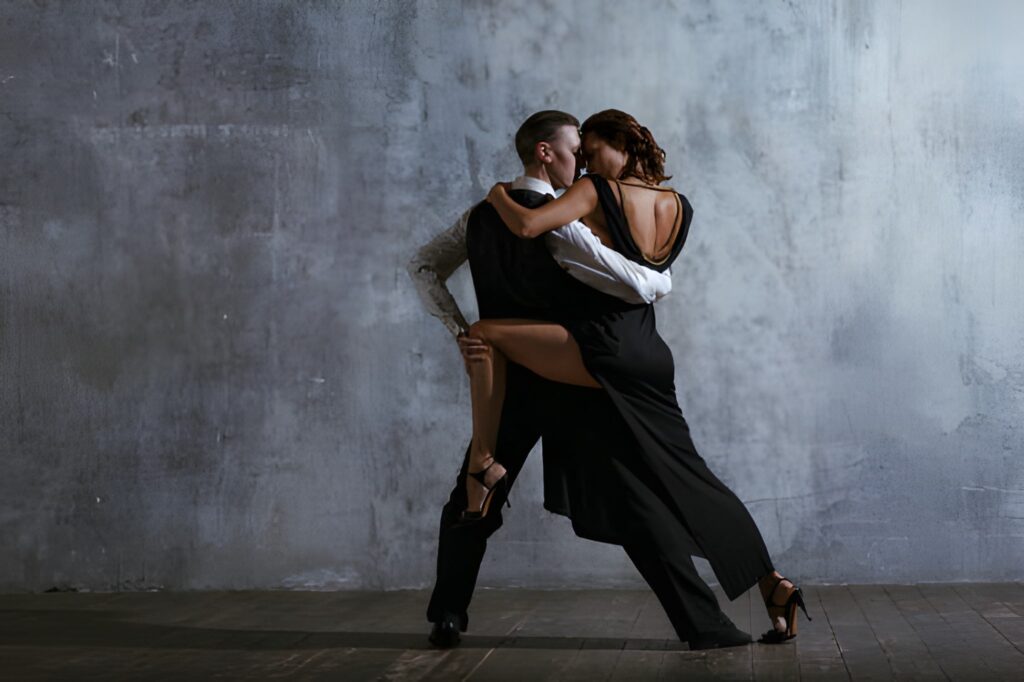
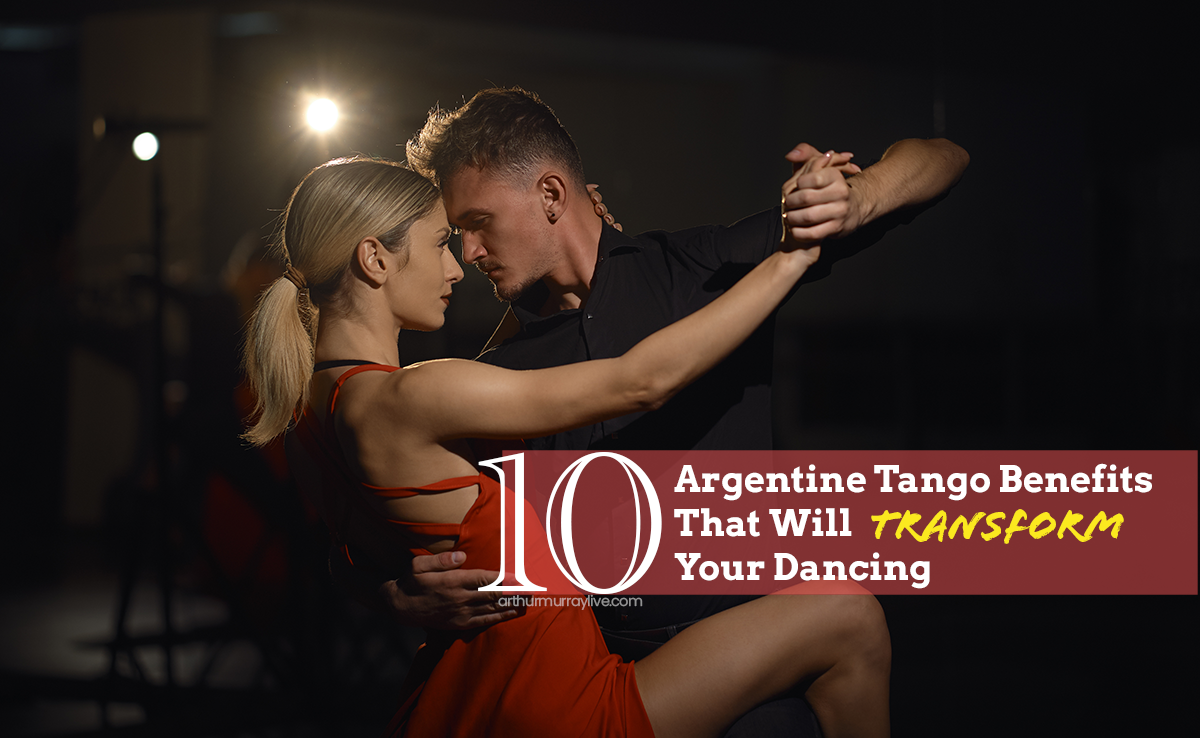
Yes, Argentine Tango is sexy. That’s the headline everyone sees. But the real story is about precision, connection, musicality, and artistry that will transform every other dance in your program.
News Flash: The Argentine Tango is Sexy
The title “Argentine Tango is Sexy” hits record levels of “obviously.”
Saying the Argentine Tango is sexy is like announcing that chocolate tastes good or that weekends are better than Mondays. If you’ve seen the dance, it’s pretty obvious. But here’s what most dancers don’t know – the sexiness might be the least interesting thing about Argentine Tango.
If you’re a ballroom dancer who hasn’t added Argentine Tango to your program yet, you’re missing one of the most transformative dances in your Arthur Murray experience. Not just because it looks so good in the movies (it does), but because it fundamentally changes how you understand partnership, musicality, and connection on the dance floor.
Here are 10 Argentine Tango benefits that prove why this dance deserves a spot in your dance hobby.
1. Yes, It’s Incredibly Sexy (Let’s Get This Out of the Way)
The Argentine Tango was so provocative when it emerged from the cafés and docks of Buenos Aires that polite society banned it. Too close. Too intimate. It was just too much leg entanglement for respectable people.
Then Paris discovered it in the early 1900s, and suddenly every high-society salon from London to New York City wanted a piece of the forbidden dance. It went from dockside scandal to international sensation because – let’s be honest – there’s something magnetic about a dance where partners move together in such close proximity.
But if sexiness was all it had going for it, the dance would have faded into novelty status decades ago. Instead, it’s grown into a worldwide phenomenon with dedicated communities in every major city. Just like any great and lasting romance, once you get past the surface appeal, you discover something beneath that’s far more compelling.
2. It’s a Master Class in Leading and Following
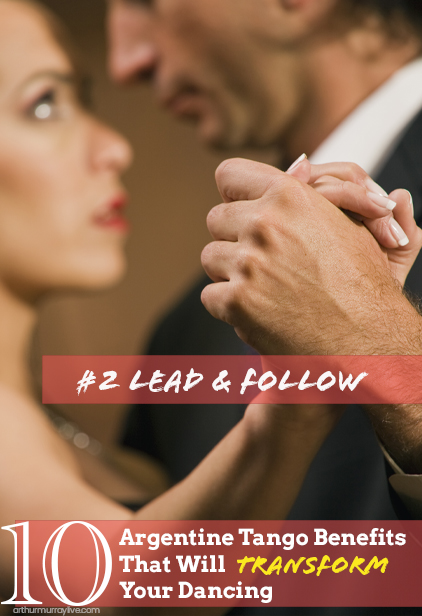
Argentine Tango is the most subtle and nuanced dance for leading and following. If American Tango is a bold and forceful speech, Argentine Tango is a whisper with someone’s lips next to your ear.
In other ballroom dances, the movements are big and sweeping. Leading and following in those dances can be like reading oversized font in an eye exam. With the Argentine Tango, the movements are delicate – a much smaller font – and because of that, it fine tunes your lead and following skills with every step.
The Argentine Tango strips away so many of the creature comforts of other social dances. While all of the other social dances adhere to a consistent tempo and base of patterns, the Argentine Tango grants full license to every leader to reimagine each pattern and interpret the timing. This makes each dance feel improvised and spontaneous. The leader must communicate intention through slight shifts in weight, gentle pressure through the frame, or a rotation of the torso. The follower must be so connected and responsive that they can feel these whisper-light signals and respond instantly.
This is why Argentine Tango dancers who cross over into other ballroom styles often become exceptional leaders and followers. They’ve trained in the graduate program of partner communication. Everything else feels easier by comparison. In fact, your Foxtrot feels easier than ever, your Waltz feels gigantic in comparison, and you’ll have a newfound appreciation for the rhythm in your Rumba.
3. Your Posture and Frame Will Thank You

The Argentine Tango’s nuanced movement requires that your frame and posture are in a great position. The process of getting into your frame almost feels like a dance itself – it’s an invitation, with two clearly defined characters, before a single salida takes place.
The close proximity of the frame creates a look of a close embrace. Both partners maintain the axis of their spines to send and receive signals with optimum clarity. While it may look like two people just giving each other a hug, that’s far from the truth. Both must keep their core engaged and take the pressure out of their hands.
Dancers who struggle with posture in other dances may find Argentine Tango to be an effective solution. While Waltz is always an easy go-to for improving posture, Argentine Tango is a sneaky upgrade to switch things up.
4. It Teaches Musical Interpretation at a Deeper Level
Most ballroom dances have a clear rhythm structure. Waltz is 1-2-3. Rumba is slow-quick-quick. Foxtrot is slow-slow-quick-quick. You count, you move, you stay on time.
Argentine Tango throws the rulebook out. Sure, it’s generally in 4/4 time, but the music is filled with pauses, accelerations, dramatic stops, and emotional swells. Think of the difference between pop music and improv jazz. You’ve got the consistent meter in one and never the same experience with the other. Argentine Tango is the improv jazz when it comes to music interpretation.
The challenge of it is what yields the greatest change. The Argentine Tango dancer that can connect with the nuances of the musicians, the change of feeling in the song, or the range of tempo by the piece develops the elusive and advanced timing upgrade: Musicality – the ability to read, react, and creatively interpret the music being played.
It’s safe to say that learning to dance Argentine Tango expands your musical vocabulary. You will start hearing subtleties in other dances that you may have missed before. In dances like West Coast Swing or Foxtrot, you’ll develop an ear for the changes when the singer or musician begins to riff. The rhythm of the Cha Cha will become easier to interpret, and even more advanced dances like Viennese Waltz will have a clearer tempo and phrasing.
5. It Develops Precise Footwork and Balance

Argentine Tango footwork is one of the first things people notice.
The signature moves – ochos (figure-eights with the feet), boleos (circular leg flicks), ganchos (leg hooks) – all require exceptional balance and foot articulation. You can’t muscle through them. They are a little dangerous and very flashy. But without a great center, the signal could float right past a less tuned in dancer.
The footwork precision you develop in Argentine Tango shows up everywhere else. Every swivel in any latin dance becomes familiar territory and the leg lines in your ballroom dances have a new reference point.
6. It Creates Instant Connection With Your Partner
There’s a reason Argentine Tango is called “the vertical expression of a horizontal desire.” The close embrace isn’t just physically intimate – it can create the look of emotional intimacy in a way that few other dances achieve.
When you dance Argentine Tango, you’re not performing for judges or an audience. It’s like a private conversation with your partner. Sometimes the conversation is romantic, other times it looks like an argument, but it is always dynamic and vibrant.
This type of dance frame and connection isn’t for everyone. In fact, most new Argentine Tango dancers will go through different versions of a practice frame before taking the close hold of this dance. After all, it requires a little vulnerability and a great knowledge of the movements before that close connection becomes a feature instead of a liability.
But when it clicks, it’s unlike anything else in ballroom dancing. Many couples report that learning Argentine Tango together deepened their relationship and utilize it everywhere from vacations to spontaneous moments in the kitchen.
7. You’ll Have “That One Special Dance” for Important Moments
Every ballroom dancer needs a signature dance – the one that might stay in bubble wrap until the timing is just right. For many dancers, Argentine Tango becomes that dance.
It’s romantic without being cheesy. It’s dramatic without being over-the-top. It works for a crowded dance floor or an empty living room. You don’t need a lot of space, you don’t need a big production – you just need good music and a willing partner.
Picture this: your anniversary dinner, a quiet restaurant with a small space between tables, and suddenly a tango comes on. Without saying a word, you stand, offer your hand, and for three minutes, you create magic in a six-foot radius. Everyone else in the restaurant stops eating to watch. That’s the power of Argentine Tango.
8. Better Space Management and Floorcraft
If you grew up in a country with small and windy roads, there’s a good chance that navigating a highway in America feels pretty boring by comparison. The reason? Those drivers trained with limited space and improved their dexterity and maneuverability as drivers.
The same can be said about your dancing. Argentine Tango is the dance equivalent of driving on a narrow, cobblestoned road. To improve in your maneuverability and dance floorcraft, this dance teaches anyone how to better utilize their dance space to thrive in crowded dance conditions.
9. You’ll Join a Passionate Global Community

Argentine Tango isn’t just a dance – it’s a lifestyle with a devoted international following. Every major city in the world has regular milongas where Tango enthusiasts gather to dance, socialize, and celebrate the culture.
When you learn Argentine Tango, you’re not just adding a dance to your repertoire – you’re getting a passport to a worldwide community. Similar to dances like Salsa, Swing or Bachata, the Argentine Tango has a wonderful following of devoted dancers. Traveling to a new city? Look up the local milonga and you’ll instantly have a social connection and a way to meet people who share your passion.
Want to take it further? The Tango community has its own culture, etiquette, and traditions. There’s the “cabeceo” (eye contact invitation to dance), the “tanda” system (sets of 3-4 songs with the same orchestra), the “cortina” (musical break between tandas). Learning these traditions adds depth to your dance experience and – let’s be honest – some serious Argentine Tango street cred.
10. It Adds Dramatic Flair to Your Overall Skillset
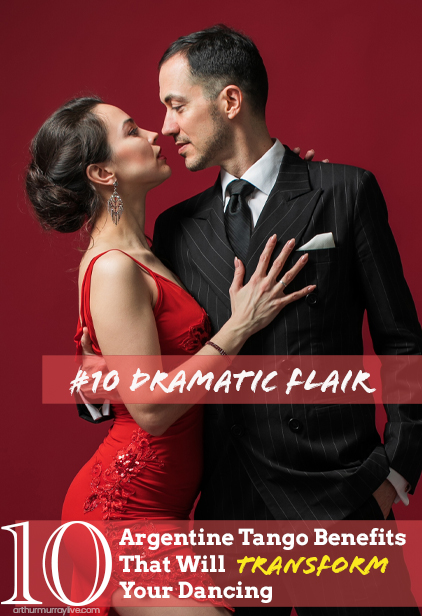
As a ballroom dancer, your goal is to develop versatility. Like a golfer that has all the right clubs in their bag, think of the Argentine Tango as your favorite hybrid club that you can use in a variety of situations.
Argentine Tango fills a great role in your dance bag. It’s dramatic, intense, emotionally charged – and it’s fun. It’s the dance you can deploy anywhere, with or without the accordion music.
Similar to an actor that performs in a wider array of roles, the Argentine Tango is a dance that gives your dance hobby dramatic range. Adjectives like sultry, intense, or provocative may not be a regular part of your day to day life, but this dance definitely will change that. This added layer of expression is a skill that will easily spill over into other dances, whether they are being performed for a large audience or for the partner in front of you.
Common Concerns (From Your Comfort Zone)
The voice in your head might be saying:
“I’m not from Argentina, I don’t have a cool accent, and all of those moves seem challenging.”
Reality: The Arthur Murray curriculum is designed to build everything in easy layers so you can make quick progress. The accent is optional (but there are rumors that’s covered in Bronze 4).
“I’m not too sure about how close I’d be to my partner. It makes me a little uncomfortable just thinking about it.”
Reality: Your ballroom dances can eventually be danced in close body contact, but that version of the frame is not mandatory. The same rules apply to Argentine Tango. The proximity to your partner will get closer over time and will always be at your comfort level.
“I’ve heard that you have to master the Argentine Tango to enjoy it. What about all of my other dances?”
Reality: The Argentine Tango pulls in resources from other dances you already know, like Tango, Waltz, Rumba, and more. Usually the people that have a binary, all or nothing, approach to learning a dance are just passionate learners – but without a lot of exposure to the Arthur Murray Interrelated System of learning. So feel free to insert the Argentine Tango in the middle of your dance program and you can experience all of the positive results it has on other dances you’ve learned.
Next Steps: How to Add the Argentine Tango
If you’re convinced that Argentine Tango should be your next dance, here’s exactly how to add it to your program:
Step 1: Mention It to Your Teacher
On your next private lesson, simply say, “I’m interested in learning some Argentine Tango. Can we explore that?” Your teacher can include that in the next part of your dance program and you will probably get a chance to test drive some basics.
Step 2: Start with the Fundamentals
Your first few lessons will focus on the essentials of the dance. You’ll probably notice some connections to dances like Waltz, even more than Tango, initially. As you begin to add layers and layer in the music, the dance will begin to develop its own identity. As exciting as this stage is, it does require patience as the foundation is being laid.
Step 3: Attend a Group Class
You should immediately earmark any Argentine Tango Group Classes or special workshops in the dance. This will build your confidence in the dance and add to your repertoire.
Step 4: Listen to the Music
Start familiarizing yourself with traditional Argentine Tango music if you want to really take this dance on the fast track. Search up orchestras like Carlos Gardel, Osvaldo Pugliese, and Aníbal Troilo. Understanding the music will accelerate your learning and deepen your connection to the dance.
Step 5: Set a Goal
Any new dance can get stuck in the “evaluation stage” for far too long – unless you set a goal to activate it. Whether that’s adding Argentine Tango to your list of dances at Showcase, signing up for a Practice Party demonstration, or making it your next solo routine – the moment you set a goal with a deadline, you begin to learn with more urgency.
Step 6: Learn the Culture
You don’t have to be born in Argentina, own an accordion, or be the part owner of a milonga in the village square to enjoy the Argentine Tango and its culture. In fact, Arthur Murray franchisee and consultant, Giuliano Scarpati is not only the author of the Argentine Tango syllabus for Arthur Murray – he’s the author of two books on the subject available now on Amazon.
Step 7: Take a Coaching Lesson
If you really want to fast track your development in any dance, including Argentine Tango, the best way to do that is with a visiting Arthur Murray consultant. They are chosen for those roles because of their incredible track records at developing skills for both students and teachers to have success with any dance, at any level, and for any environment.
Final Thought: The Most “Obviously” Good Decision You’ll Make
Looking back at this article, the title really should have been “News Flash: Argentine Tango Will Make You a Better Dancer in Ways You Didn’t Expect.”
Yes, it’s sexy. That’s the headline everyone sees. But the real story is about precision, connection, musicality, and artistry. It’s about adding a dance to your program that challenges you in completely different ways than your other ballroom dances. It’s about joining a global community and developing skills that elevate everything else you do on the dance floor.
On your next private lesson, mention that you’re interested in adding Argentine Tango. Give your teacher a chance to show you the subtle lead-and-follow connection, the musical interpretation possibilities, and those undeniably sexy leg lines that started this whole conversation.
Hopefully, with one small step outside your comfort zone, you’ll look back on this decision with the same record levels of “obviously” – obviously the right choice, obviously something you should have started sooner, and obviously one of the most rewarding additions to your dance journey.
Because once you experience the whisper-close connection of Argentine Tango, you’ll wonder why you waited so long to discover it.